Garlic Sauce and Good Advice: The Midnight Philosophy of Britain's Curry and Kebab Shops
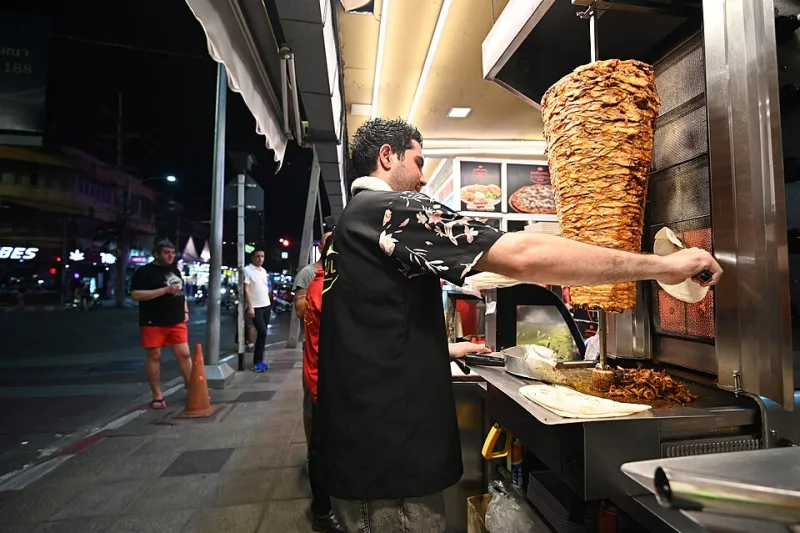
Photo: PattayaPatrol, CC BY-SA 4.0, via Wikimedia Commons
It's ten past midnight on a Friday in Sheffield. The kebab shop on London Road is doing the kind of business that would make a restaurant manager weep with joy. The counter is four-deep with people who fall broadly into three categories: those who've been out drinking and are now navigating a menu with the intensity of someone defusing a bomb, those who've just finished a night shift and want something hot and uncomplicated, and one bloke who comes in every Friday regardless of whether he's been drinking, because this is simply what he does on Fridays.
Behind the counter, Yusuf has been here since five in the afternoon. He will be here until four in the morning. In the intervening hours, he will serve somewhere between two and three hundred people. He will also, without intending to, become the most important conversationalist in the lives of approximately a dozen of them.
"People talk to me about everything," he says, shaving meat from the doner with the practised ease of someone who has done this tens of thousands of times. "Breakups, job problems, whether they should move to another city. Last week someone asked me if they should propose. I said yes. She'd already said no once. I told him try again."
The Unofficial Community Hub
Britain has a complicated relationship with the idea of the European café — that romantic notion of the pavement table, the hours-long espresso, the unhurried conversation that stretches into the evening. We don't really do that. Our café culture tends to close at five, our pubs enforce last orders, and our restaurants are increasingly reluctant to let you linger past the two-hour mark.
But the late-night kebab shop and curry house? Those stay open. And in doing so, they've quietly become something that nobody planned but everyone, it turns out, needed: a place where the social rules are different, the conversation is real, and nobody is asking you to leave.
"There's no booking system at midnight," points out Amara, 29, a nurse who comes into her local curry house in Leicester after late shifts. "You just walk in. You're treated like a person. It's warm. That matters more than you'd think when you've been on your feet for twelve hours."
The physical space of these places matters too. Strip lighting, laminate tables, menu boards with photographs that may or may not accurately represent the food — none of it is designed with Instagram in mind, and that's precisely why it works. There's no performance required. You can look exhausted, dishevelled, or mildly chaotic, and nobody bats an eyelid, because everyone else looks the same.
The Art of the Counter Chat
There is a specific kind of conversation that happens across a kebab shop counter that doesn't happen anywhere else. It's not the forced cheerfulness of a coffee chain interaction. It's not the professional politeness of a sit-down restaurant. It's something more direct, more honest, and occasionally more useful.
"The guys at my local know my order before I say it," says Jamie, 24, a bar worker in Glasgow. "But they also know when I've had a rough night. They don't make a big deal of it. They just... adjust. More chips. Maybe a comment that makes me laugh. It sounds small but it's not."
This is the unspoken social contract of the late-night food establishment: the staff will feed you without judgement, and in return you will treat them with basic human decency. It is, when you spell it out, a remarkably simple agreement. And yet the number of people who honour it with genuine warmth — who say thank you and mean it, who ask how the night's going, who remember names — is striking.
Khalid, who has run a curry house in Birmingham for twenty-two years, describes his regulars with the kind of detail you'd associate with a long-standing friendship. He knows who's going through a divorce, who just got a promotion, who has a mother in hospital. "I don't ask," he says. "They just tell me. I think it's because there's no agenda here. I'm not going to see their colleagues. I'm not going to tell anyone. I'm just here."
Who Actually Goes to These Places?
The late-night food ecosystem is more diverse than its reputation suggests. Yes, there are the post-pub crowds — noisy, cheerful, occasionally indecisive about whether they want chilli sauce on that. But they share the space with night shift workers from hospitals, warehouses, and call centres. With insomniacs who've given up on sleep and decided a lamb bhuna is a better use of the next hour. With couples who've had an argument and needed neutral territory. With students who've been in the library until midnight and need something that isn't a cereal bar.
"I came in here after my mum's funeral," says Preethi, 38, quietly, about the curry house near her home in Coventry. "Not immediately after — later that night. I didn't want to sit in the house. I didn't want a pub. I just wanted to be somewhere warm where someone would bring me food and not ask me how I was doing. And they didn't. They just brought the food. It was exactly right."
That instinct — to provide without interrogating — is something these places have refined over decades. The curry house and the kebab shop are not trying to be your therapist. But they are, in their own way, performing a function that no other British institution quite manages at that hour.
Why This Matters More Than We Admit
There's a tendency to treat late-night food spots as purely functional — fuel stations for the inebriated, a step above a vending machine. But that framing misses something important about what they actually do for the communities around them.
In neighbourhoods where the pub has closed, the community centre has lost its funding, and the high street is half-empty, the curry house and the kebab shop are often the last places that are reliably, consistently open — and reliably, consistently welcoming. They don't require a reason to visit. They don't require a reservation or a dress code or a minimum spend.
Yusuf puts it simply, between orders, as the queue at the counter shifts and reshuffles itself. "People come here to eat. But they stay because it feels normal. Like a normal place to be. Not everyone has that at midnight."
He hands over a doner wrap — extra garlic sauce, chilli on the side — and turns to the next person in line. Outside, Sheffield carries on doing what cities do at midnight. Inside, the conversation continues.