Same Spit, Different City: The Quiet Regional Revolution Happening Inside Britain's Kebab Shops
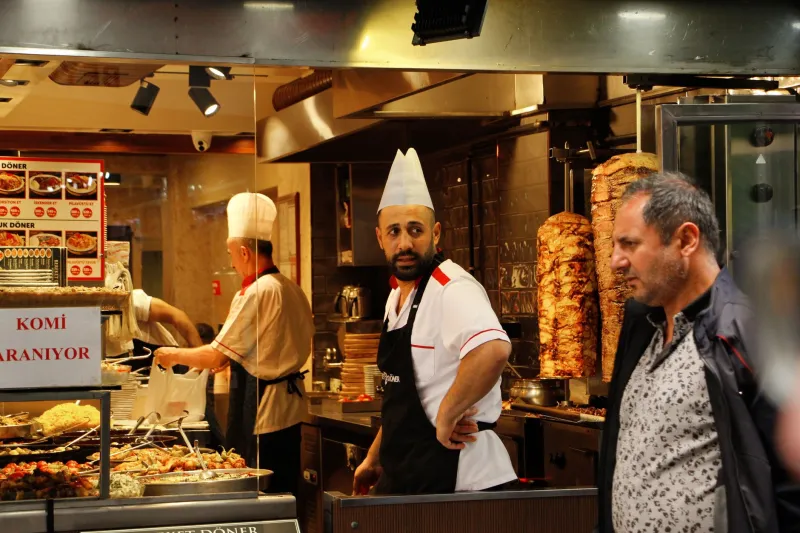
There's a moment, usually somewhere around midnight and always slightly regrettable in the morning, when you're standing in front of a kebab shop counter trying to make sense of what you want. Chilli sauce or garlic? Pitta or flatbread? Salad or no salad? And underneath all of that — the question nobody really asks out loud — is whose version of this are you actually getting?
Because here's the thing about the British doner kebab: it is not a single dish. It's a family of dishes, loosely related, wildly different in execution, and fiercely defended by whoever grew up eating their local version. A kebab in Stoke is not a kebab in Edinburgh. A wrap from a Manchester late-night spot shares almost nothing — beyond the rotating meat — with what you'd get in a Turkish-run shop in Hackney. The spit might look the same. The rest is up for debate.
How the Doner Became Everyone's and No One's
The doner kebab arrived in Britain via Turkish and Turkish-Cypriot communities from the 1960s onwards, with the first shops establishing themselves in London before spreading north and outward through the following decades. But 'spreading' is doing a lot of heavy lifting in that sentence, because what actually happened was more complicated — and more interesting — than simple replication.
Each new wave of migration brought its own culinary traditions, its own ideas about spice blends and meat ratios, its own suppliers and its own clientele. A Bangladeshi-run kebab shop in Bradford approached the food differently to a Kurdish-run one in Tottenham. An Afghan family setting up in Coventry brought flavours that had nothing to do with the Turkish original. The word 'kebab' became an umbrella — enormous, slightly wobbly — covering everything from a tightly spiced lamb doner to a grilled shish that would make a Turkish grandmother proud.
And then the British public got involved and, honestly, made things even more interesting.
The North-South Divide Is Real and It's Delicious
Spend any time talking to kebab shop owners across the country and you'll hear the same thing framed in completely different ways: we do it properly here. Everyone thinks their version is the correct one. Nobody is entirely wrong.
In London, particularly in areas with strong Turkish communities — Green Lanes, Dalston, bits of Haringey — you'll find doner that skews closer to the original: lamb-heavy, seasoned with cumin and oregano, served in a proper flatbread with little fuss. The sauce situation is relatively restrained. The meat is the point.
Head north to Manchester's Rusholme — the legendary Curry Mile, which has always been more complicated than its nickname suggests — and the kebab culture has been shaped by a predominantly South Asian clientele and ownership. The spicing shifts. Chilli heat becomes more central. The bread choices expand. You'll find naan used where a London shop would default to pitta without a second thought. And the garlic sauce? Often homemade, often extraordinary, and often the actual reason people keep coming back.
Birmingham has its own thing entirely. Balsall Heath and Sparkhill have a dense concentration of Kashmiri and Pakistani-run kebab spots where the doner meat itself is often blended differently — leaner in some places, heavier on the beef, with spicing that reflects the subcontinent rather than the Bosphorus. Order a 'mixed kebab' here and you might get something that would genuinely confuse a Londoner.
It's the Meat, Obviously
The elephant in the room — or more accurately, the slowly rotating cone of it — is the meat itself. Where it comes from, how it's blended, and who's supplying it varies enormously by region, and it makes a bigger difference than most people realise.
Halal certification is standard across the vast majority of British kebab shops, but within that, the sourcing diverges significantly. Some urban shops — particularly in London and Birmingham — use local halal butchers they've had relationships with for decades, getting custom blends of lamb and beef made to their own specifications. Others use large national suppliers, which keeps costs down but smooths out the regional character.
One shop owner in Sheffield, who'd rather not be named but has been running his place for over two decades, puts it plainly: "The meat I use, I've been getting from the same guy for eighteen years. He knows what I want. If I switched suppliers, my regulars would notice within a week. They wouldn't know why, but they'd know something was off."
That kind of institutional knowledge — built up over years, quietly passed between owner and supplier — is what creates the local character that no chain can replicate. It's also why kebab tourism is an underrated British pastime.
The Sauce Situation (A National Emergency)
If the meat is the foundation, the sauce is where regional identity really gets territorial. And the British public has opinions.
Chilli sauce in Scotland often runs hotter and redder than its southern counterparts, with some Glasgow shops using blends that would raise eyebrows elsewhere. White garlic sauce — that creamy, slightly tangy stuff that coats everything — is non-negotiable in most of the Midlands but treated almost as an afterthought in some parts of London where the meat is supposed to speak for itself. In parts of Yorkshire, you'll find shops offering curry sauce as a kebab accompaniment, which is either genius or heresy depending entirely on where you were born.
And then there's the question of whether the sauce goes inside the bread or on the side, which is genuinely the kind of thing that ends friendships.
Why This All Matters
It would be easy to look at all of this variation and call it chaos. It isn't. It's something much more interesting — it's a food culture that's been genuinely shaped by the communities it feeds, rather than handed down from a central authority with a brand manual.
Britain's kebab shops are, collectively, one of the great unsung stories of how migration reshapes food. The dish arrived from one place and became something entirely new — or rather, dozens of new things — through contact with different cultures, different climates, different local tastes. The Turkish original is still in there somewhere, but it's been remixed, adapted, and argued over until it belongs to all of us.
Next time you're standing in front of that counter at an unreasonable hour, maybe think about that. Or don't. Just get the chilli sauce on the side and stop holding up the queue.
Wishi-Washi Eats is always on the lookout for regional kebab gems. Got a shop we need to know about? You know where to find us.