Grease, Wisdom, and Strangers: The Unsung Philosophy of the Late-Night Takeaway Queue
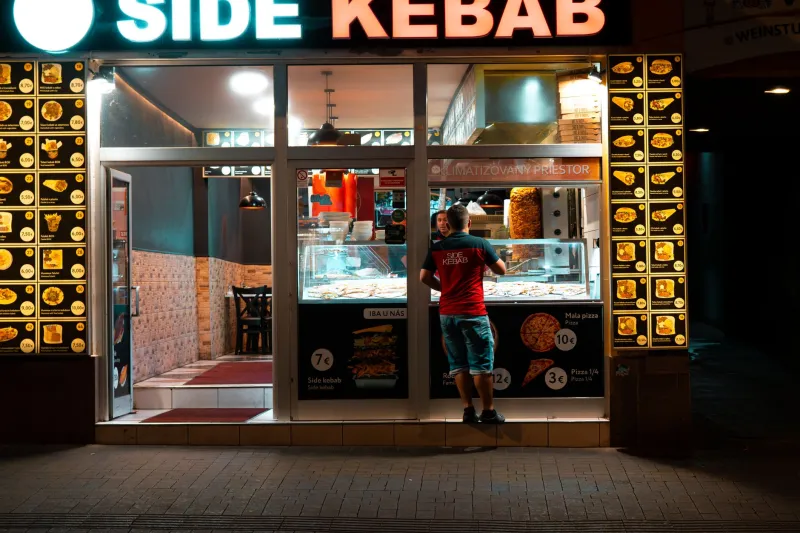
It's quarter past two on a Saturday morning. The kebab shop on the high street has been open since eleven, but it's only now — properly now — that it becomes something else entirely. The fryer is singing. The tiles are doing that thing where they're technically clean but also somehow permanently glazed with the memory of every chip ever dropped on them. And three strangers who have never met before are having what might be the most honest conversation of their respective weeks.
This is Britain. This is the late-night takeaway. And we don't talk about it nearly enough.
Nobody Comes Here for the Ambience
Let's be clear about what these places are not. They are not gastropubs with exposed brickwork. They are not curated dining experiences with a QR code menu and a cocktail list. The seating — if there is any — is usually a narrow bench bolted to the wall, and the lighting is the kind that makes everyone look equally knackered and equally honest. There's a freedom in that.
When you strip away comfort and pretension, something interesting happens: people actually talk to each other. Not the polite, curated chat of a dinner party, but real conversation. The kind where someone you've never met tells you they're thinking about leaving their job, and you tell them to do it, and somehow that advice lands because neither of you has anything to lose from the exchange.
The kebab shop doesn't judge you. It just hands you a tray of chips.
The Queue Is the Thing
Sociologists have spent decades studying how public spaces shape human behaviour. They could save themselves a lot of bother by spending a Friday night in a chippy queue in Leeds or a doner shop in Peckham.
The queue is where it all happens. It's long enough to force conversation but short enough that nobody's committed to anything. You're shoulder to shoulder with people you'd never normally speak to — different ages, different postcodes, different everything — and the shared experience of waiting, hungry, slightly worse for wear, creates a strange and temporary kinship.
Someone compliments someone else's trainers. Someone asks what the lamb shish is like. Someone makes a joke about the price of everything these days, and three people laugh, and for a moment the entire queue is a single organism with a shared opinion. It's almost beautiful. It definitely smells of garlic sauce.
The Man Behind the Counter Has Heard Everything
Ask anyone who's worked a late-night food shift and they'll tell you the same thing: the stories don't stop. Proposals, breakups, philosophical crises, career revelations, deeply questionable life plans — they've all been aired over a counter while someone waited for their order.
There's a reason for this. The person serving you is a fixed point in a chaotic night. They're sober, they're focused, they're not going anywhere. That makes them, by default, the most grounded person in the room. People talk to them the way people used to talk to barbers — not because they asked for it, but because the dynamic makes it natural.
Some of these conversations are daft. Some of them are surprisingly profound. And some of them — the ones about loneliness, about not knowing what comes next, about missing someone — are the kind you'd never have in daylight.
Regional Flavours, Same Human Chaos
The late-night food landscape shifts depending on where you are, but the social alchemy stays constant. In Glasgow it might be a late-night chippy doing a deep-fried pizza supper. In Cardiff, a chicken shop. In Manchester, a curry mile takeaway still buzzing at 3am. In Norwich, a van parked outside a nightclub doing hot dogs that are frankly better than they have any right to be.
The specifics differ. The feeling doesn't. Wherever you are in Britain, the late-night takeaway is doing the same job: giving people somewhere to land.
Why This Actually Matters
We live in an era of hyper-curated social lives. We choose our restaurants carefully, our friendship groups deliberately, our online communities algorithmically. Everything is optimised for comfort and familiarity. The late-night takeaway is the last truly random social space most of us ever enter.
You cannot filter who's in that queue. You cannot choose the vibe. You just show up, hungry, and whatever happens, happens. And what happens is often surprisingly good — funnier, warmer, and more human than anything you planned.
There's a reason people talk about these moments years later. Not the food, necessarily (though a good doner at 2am is genuinely one of life's pleasures). But the night they ended up in a kebab shop in Sheffield talking to a retired electrician about whether life gets easier. The night someone in the queue convinced them to text back. The night a stranger said exactly the right thing at exactly the right time, then disappeared into the dark with a polystyrene tray.
The Unwritten Rules
Every late-night food spot has its own micro-culture, but a few things hold true across the board. You don't push in. You share the sauce bottles without being asked. If someone's clearly had a rough night, you give them space. And if someone's clearly had a brilliant night, you let them tell you about it, even if it takes until your order's ready.
These aren't posted anywhere. Nobody taught them. They just exist, passed down through collective understanding, the way all the best social norms are.
Long Live the Greasy Confessional
Britain is not a nation known for its emotional openness. We apologise when someone bumps into us. We describe genuinely terrible experiences as "not ideal." We would rather suffer in silence than inconvenience anyone with our feelings.
And yet. Put us in a queue at half two in the morning with fluorescent lights overhead and the smell of frying onions in the air, and something shifts. The walls come down. The chat starts. The honesty creeps in.
The kebab shop didn't set out to be a community hub. It just stayed open late, kept the lights on, and let people in. Sometimes that's all it takes.