Battered, Battered, and Utterly Battered: We Ranked Britain's Chip Shop Cultures So You Don't Have To
Battered, Battered, and Utterly Battered: We Ranked Britain's Chip Shop Cultures So You Don't Have To
There are a few things that unite the British public regardless of politics, postcode, or Premier League allegiance. A good moan about the weather. An inexplicable fondness for queueing. And the chippy.
But here's the thing nobody wants to admit at the counter: not all chippies are created equal. The nation's most beloved takeaway institution varies wildly depending on where you're standing — and those differences matter enormously to the people who've grown up with them. Ask a Glaswegian about curry sauce and they'll look at you like you've suggested putting pineapple on a pie. Ask someone from Middlesbrough and they'll tell you gravy is basically an insult.
We've toured the regions, eaten more chips than is medically advisable, and we're ready to deliver our verdict. Buckle up.
Scotland: The Deep-Fried Everything Capital of the Known World
Let's start in Scotland, where the chippy isn't just a takeaway — it's a cultural institution with the audacity to batter literally anything. The Scottish 'chippy' experience is defined by two things: extraordinarily thick, crispy batter and a complete lack of shame about what goes inside it.
The chips themselves tend to be chunky, floury, and cooked in beef dripping at many traditional establishments — a detail that makes them taste like proper chips rather than the pale, limp offerings you'll find in lesser postcodes. The fish supper up here is a serious affair: a fat fillet of haddock (not cod — don't make that mistake) encased in batter so thick it practically needs its own postcode.
And then there's the deep-fried Mars bar. Yes, it's real. Yes, people actually eat them. And yes, they are disgusting and magnificent in equal measure.
Scottish chippies also tend to offer pickled onion, a smear of brown sauce, and the kind of no-nonsense service that feels like being told off by a beloved auntie. Salt and sauce — a curious brown-vinegar hybrid specific to Edinburgh — is non-negotiable.
Verdict: Maximum drama, maximum flavour, maximum caloric consequence. Scotland earns top marks for sheer commitment to the bit.
Northern England: The Gravy Heartland
Cross the border into Northern England and you enter gravy territory. Yorkshire, Lancashire, Greater Manchester — these are places where the question isn't whether you want gravy, it's whether you want it in a tub or poured directly onto the chips like a warm, savoury baptism.
Northern English chippies tend to favour a slightly thinner batter than their Scottish counterparts, with a satisfying crunch that holds up even under a generous dousing of said gravy. The chips here are often a touch thinner too — less chunky, more golden, and absolutely built for vinegar absorption.
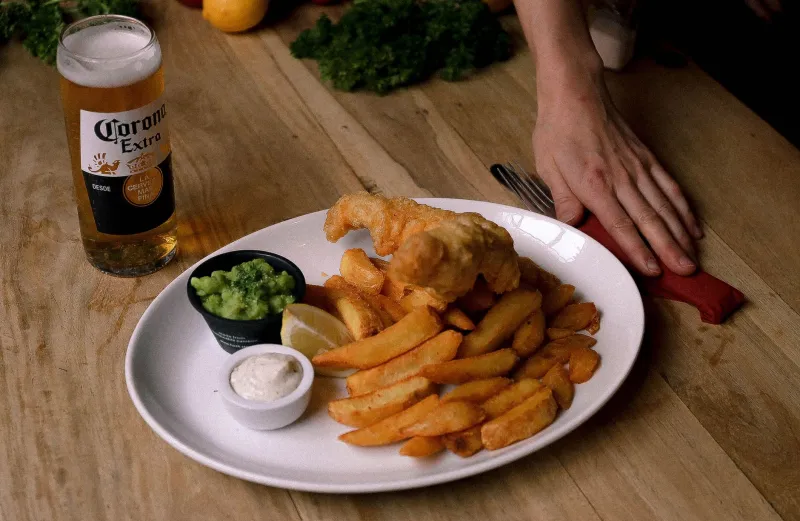
Mushy peas are practically mandatory. Served warm, slightly fluorescent green, and eaten with a small wooden fork that disintegrates after three uses — this is the side dish that defines Northern chippy culture. Pie and chips is also a staple, particularly in Lancashire, where a proper meat-and-potato pie sitting atop a pile of chips is considered a balanced meal.
The North East deserves its own paragraph. Newcastle and Sunderland operate on a slightly different frequency — here, Parmo (a breaded chicken escalope smothered in béchamel and cheese) has become a chippy staple that the rest of the country is only just beginning to understand.
Verdict: Gravy, mushy peas, and genuine warmth. Northern England is the comfort food capital of Britain and it knows it.
📦 SIDEBAR: What to Order Beyond Chips Forget the fish for a moment. Here's what else is worth your 50p:
- Scotland: White pudding supper (trust us), pickled egg
- North England: Parmo (North East), pie and chips, battered sausage
- Wales: Curry chips, battered spam fritter
- South England: Saveloy, rock eel, jellied eels (London only, approach with caution)
Wales: The Underrated Contender
Wales doesn't get nearly enough credit in the national chippy conversation, and frankly that's a travesty. Welsh chip shops — particularly in the South Wales valleys — have developed a fiercely loyal curry chip culture that rivals anything the North of England has to offer.
The curry sauce here is thick, slightly sweet, and unmistakably different from the watery yellow stuff you'll find elsewhere. It coats the chips like a warm blanket and pairs brilliantly with a battered sausage or a portion of scampi. Welsh chippies also tend to be genuinely good value — a large chips and curry sauce for under three quid is still achievable in many towns, a fact that should be celebrated loudly.
The batter tends to be lighter and crispier than Scottish versions, which divides opinion, but the overall quality of the fish is consistently high — Wales has the geographical advantage of genuinely fresh coastal catches in many areas.
Verdict: Criminally underrated. If Welsh chippy culture had better PR, it'd be a national treasure.
Southern England: The Mixed Bag
Right, let's be honest here. Southern England's chip shop scene is... inconsistent. London in particular is a city of extremes — you can find genuinely brilliant traditional chippies in places like Poppies in Spitalfields or the Rock & Sole Plaice in Covent Garden, but you can also find absolutely dismal, soggy, overpriced nonsense being sold out of a polystyrene tray on every high street.
The South tends to favour cod over haddock, thinner chips, and a much more restrained approach to condiments — salt and vinegar, maybe some ketchup, and that's your lot. The saveloy is a Southern staple that bewilders the rest of the country: a bright red, slightly spiced sausage that tastes like a hot dog's more confident cousin.
Coastal towns are a different story entirely. Whitstable, Brighton, Padstow — these places take their fish seriously, and rightly so. A proper seaside chippy with fresh-caught fish, eaten from paper while sitting on a wall in the wind, is one of life's genuinely great experiences regardless of regional allegiance.
Verdict: Patchy. The highs are high, but the lows are very, very low.
⏰ SIDEBAR: Best Times to Visit a Chippy
- Friday lunchtime: The classic. Freshest oil, freshest fish, and you'll beat the tea-time queue.
- After the pub (10-11pm): Chips taste 40% better after two pints. Science.
- Saturday afternoon in winter: A large chips with gravy is basically a hug in a tray.
- Avoid: Sunday evenings at many chippies — they're often closed, and the ones that aren't have been cooking in tired oil since Thursday.
And the Winner Is...
Right. Decision time. On the basis of texture, value, overall vibe, and that indefinable quality we at Wishi-Washi Eats call the thing — that feeling when you open the bag and the vinegar steam hits your face — our regional champion is Northern England.
It's not the flashiest answer. Scotland has the drama and the deep-fried audacity. Wales has the underdog charm. But Northern England's chippy culture wins because it's the most complete. The chips are excellent. The gravy is genuinely life-affirming. The mushy peas are an institution. The value is extraordinary. And the whole experience — from the queue, to the paper-wrapped parcel, to eating it on the walk home — feels like exactly what a chippy should be.
🗞️ SIDEBAR: Why the Paper Wrapping Actually Matters Polystyrene trays keep chips hotter for longer, technically. But paper wrapping — proper newsprint, or at minimum greaseproof — creates steam that keeps chips moist while simultaneously making them smell incredible. It also means you have to eat them quickly, which is exactly the point. Chips aren't a slow food. The paper enforces the right behaviour.
Scotland, we love you. Your chips are magnificent and your battered Mars bars are a national treasure. But Northern England edges it — just barely, and only because of the gravy.
Don't @ us. (Actually, do. We love a chippy argument.)
Hungry? Good. Go find your local chippy. It's probably better than you remember.